Conversations
A record exists only when someone writes it. Much of what matters is said in passing, in the conversation. post-cortex can keep the conversation too, apart from the records, so that what was said can still be found, and a record can show the words it came from.
Not everything important becomes a record
Section titled “Not everything important becomes a record”The agent records the decisions, fixes and changes it recognizes as important. But a lot of knowledge is said in passing: a requirement mentioned between two tasks, a reason given in a reply, “don’t do that again”.
It happened to us while writing this documentation, and here it is again in a test workspace. Alex asks the agent to set up a docs site, then says in passing, between two tasks: “Good, go on with the quickstart. And keep this in mind: the docs and the site are the face of the product, so every page gets a second review after it is written.” The agent goes on with the quickstart and writes no record of it. Three weeks later nobody would know why every page is reviewed twice.
Keeping the conversation
Section titled “Keeping the conversation”When it is turned on, post-cortex also keeps the conversation: every question from the user and the agent’s final reply, in a stream for the session, apart from the records.
- What is kept: the text of the question, the final reply, the names of the tools used and the paths of the files they touched. Tool output is never sent.
- Apart from the records: the conversation does not go into the graph, the session summary or the importance scores. It does not dilute the records.
- Hidden data: passwords, keys, email addresses, phone numbers and public IP addresses are replaced with
[REDACTED:<kind>]before anything is stored, as with records. - Off by default. You turn it on for your agent when you connect it. In Claude Code the plugin sends each turn after the reply, in the background; if that fails, the work is not affected.
- How long: 90 days by default, then the turn is deleted and leaves search too. On your own daemon the period is a setting, and it can be forever. One turn or the whole conversation can also be deleted by hand.
How it is searched
Section titled “How it is searched”The conversation is searched only when asked for: the records, the conversation, or both. By default only the records are searched, so that confirmed knowledge and things said in passing are not mixed.
Those words, searched in that workspace:
| Searching | First result |
|---|---|
| the records | the decision to build the site with Astro Starlight (0.952): not it |
| the conversation | Alex’s turn itself (0.820) |
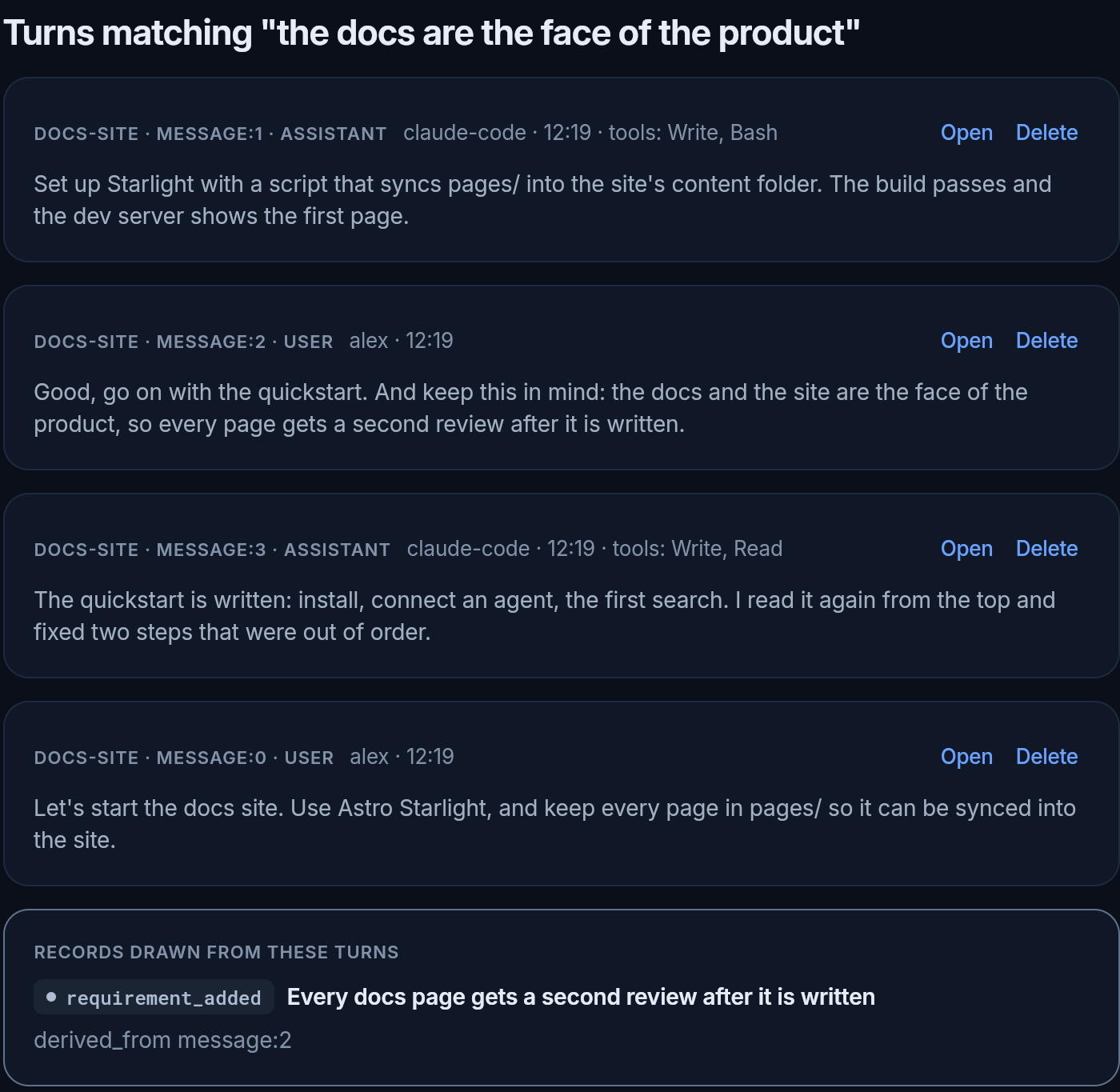
Every turn found comes whole, with the turns around it in the order they were said, so you can see what it was said about:
From conversation to record
Section titled “From conversation to record”When something in the conversation deserves to stay, the agent records it and names the turns it came from. The record then carries its origin: who said it, when, and in which conversation.
Here the agent made a requirement of Alex’s turn: every docs page gets a second review after it is written. It names the turn it came from, search returns it with that link, and the app shows it under the turns it was drawn from (above) and leads from the record back to the turn. If the turn is deleted, the record keeps a trace of it.
What it solves
Section titled “What it solves”- Nothing said is lost entirely. Even when the agent writes no record, what was said can be found while the conversation is kept.
- The records stay clean. The conversation is a separate source: searched when asked for, with no effect on the graph.
- Every record can show where it came from. It names the turns it was drawn from, and the app leads back to them.
- You control the data: off by default, no tool output, sensitive data hidden, a retention period, and deletion by hand.
For agents and scripts: searching the conversation with the search tool and the REST API.