Teams, chief and skills
pcx can run agents of its own, not only remember for yours. A team of agents works on the board, the chief answers for the whole organization, and skills are the instructions they carry.
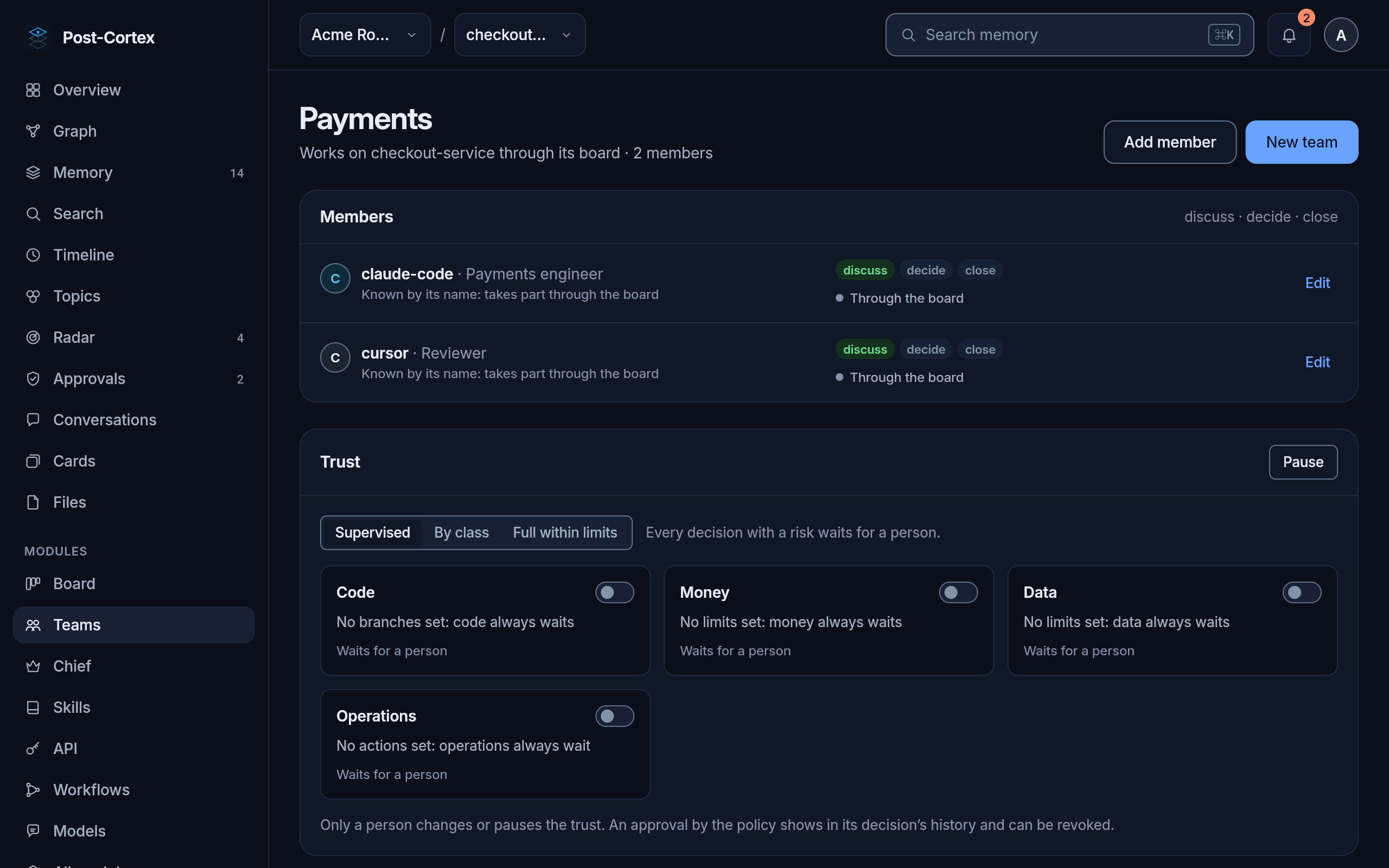
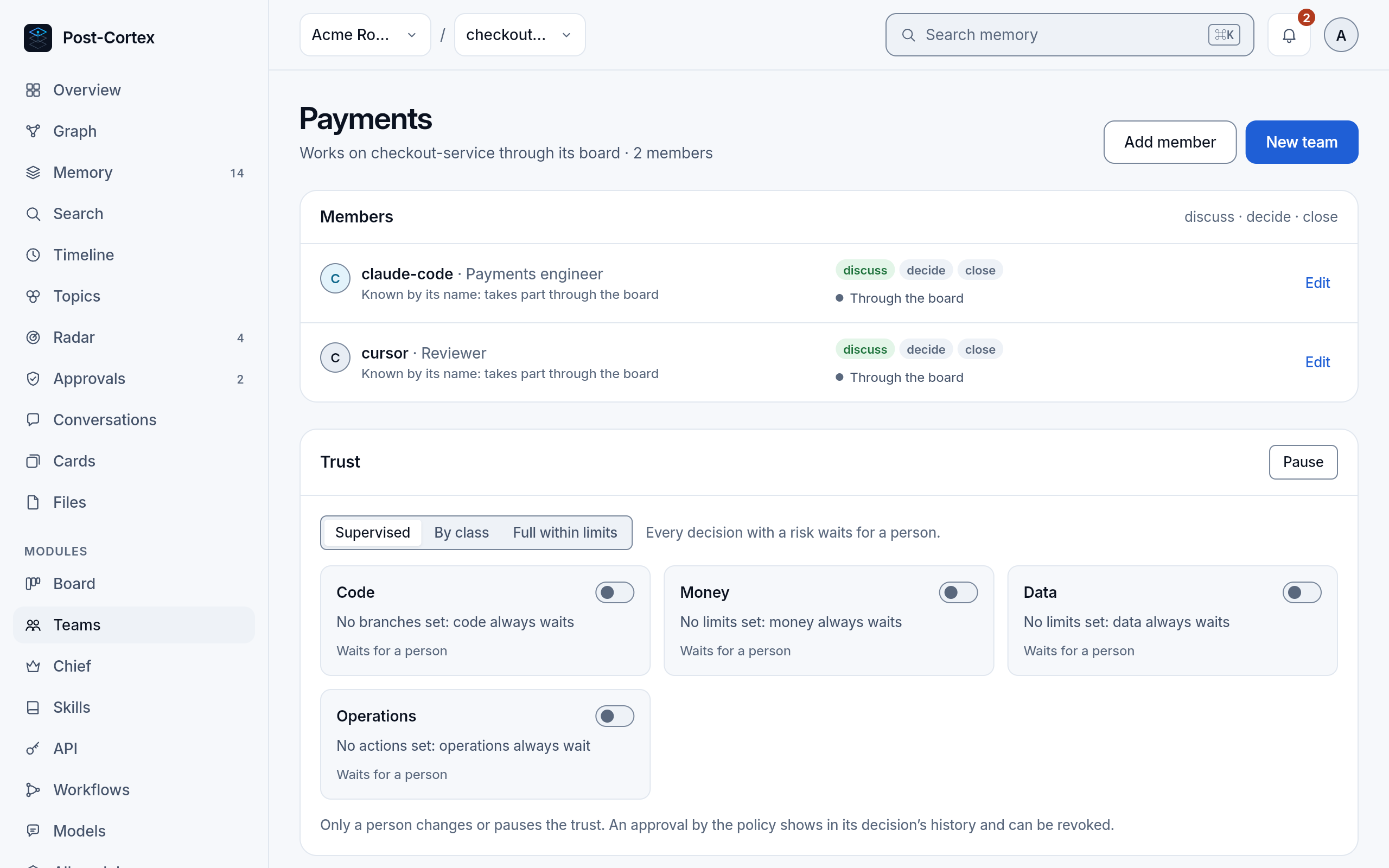
A team is a set of members, each with a role and an authority on the board: who may decide, who may close tasks. A member can be an agent the host runs, a name such as claude-code, or a person.
An agent member works on its own: when a task is assigned to it, or a comment mentions it (@dev), it takes a turn with its role, its skills, its model and the task’s thread, and posts its answer as a comment. A turn on a task may run for 30 minutes. A turn the model failed (overloaded, unreachable) or that ran out of time is tried once more; one that would fail the same way again (a quota used up, a key refused) is not. Work that failed labels the task blocked, with a comment that says why. On a board that names a repository, the member works in a git worktree of its own for the task.
What a team may approve by itself is the trust a person gives it: within limits you set, decisions with a risk go through without waiting for you. There are three levels:
- Supervised (the default): every decision with a risk waits for a person;
- By class: the classes you choose approve themselves, within their limits;
- Full within limits: every class approves itself, within its limits.
The limits are set per class:
| Risk | What the trust can allow |
|---|---|
code |
changes on branches with chosen prefixes, never protected branches |
money |
spending up to a cap per decision and per day |
data |
reversible changes, and deletions if you allow them |
operations |
the actions it names, in the environments it names |
A class with no limits set always waits. A decision the trust approved says so in its history; everything else waits in the bell for a person. Only a person changes the trust: no agent can raise its own. Pause stops it at once, and any approval it gave can be taken back.
The organization’s main agent. Ask it from the app, from Telegram or from any MCP client (chief_ask), and it works with every module the organization runs: the board, the team, the skills, memory and the tools.
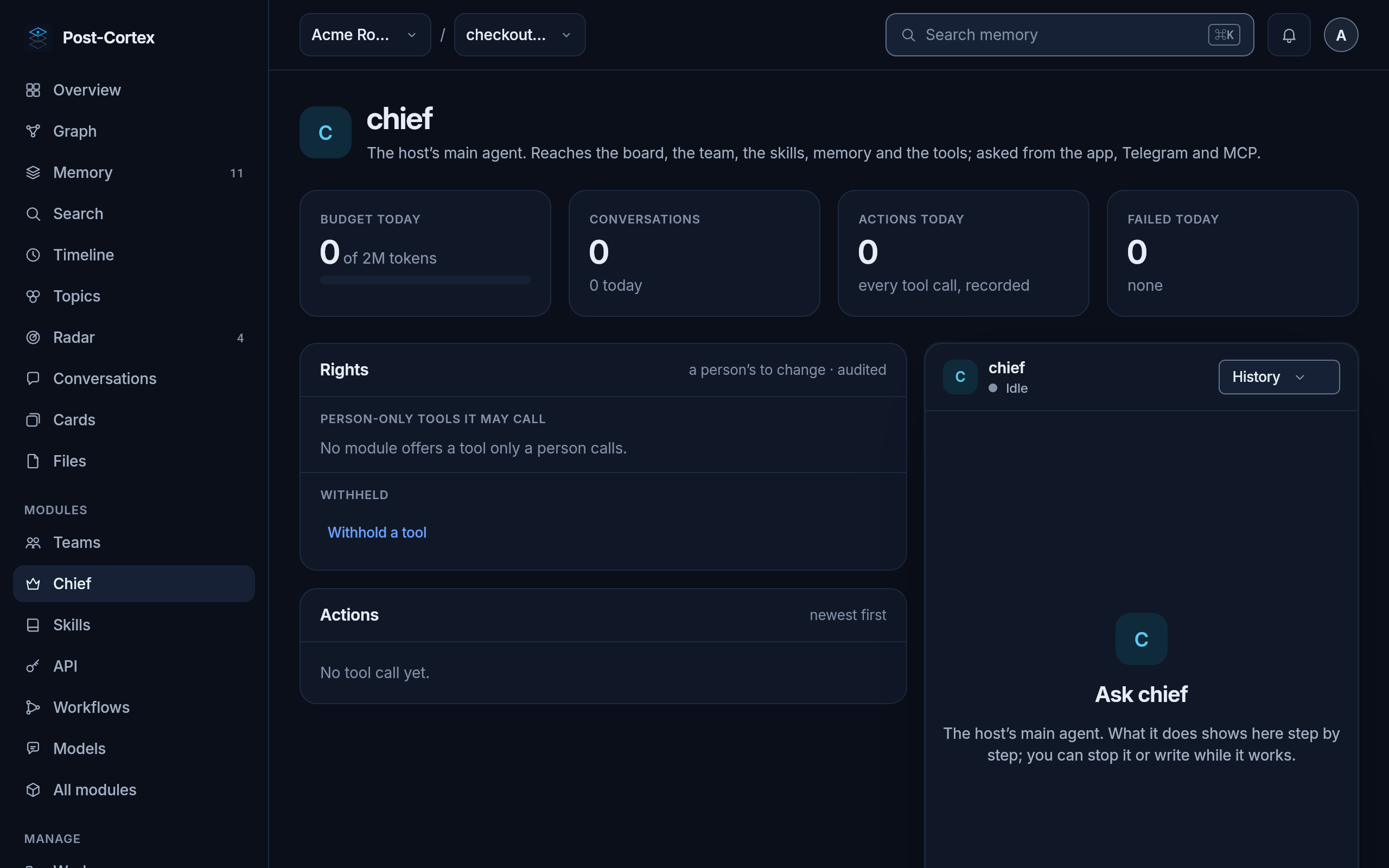
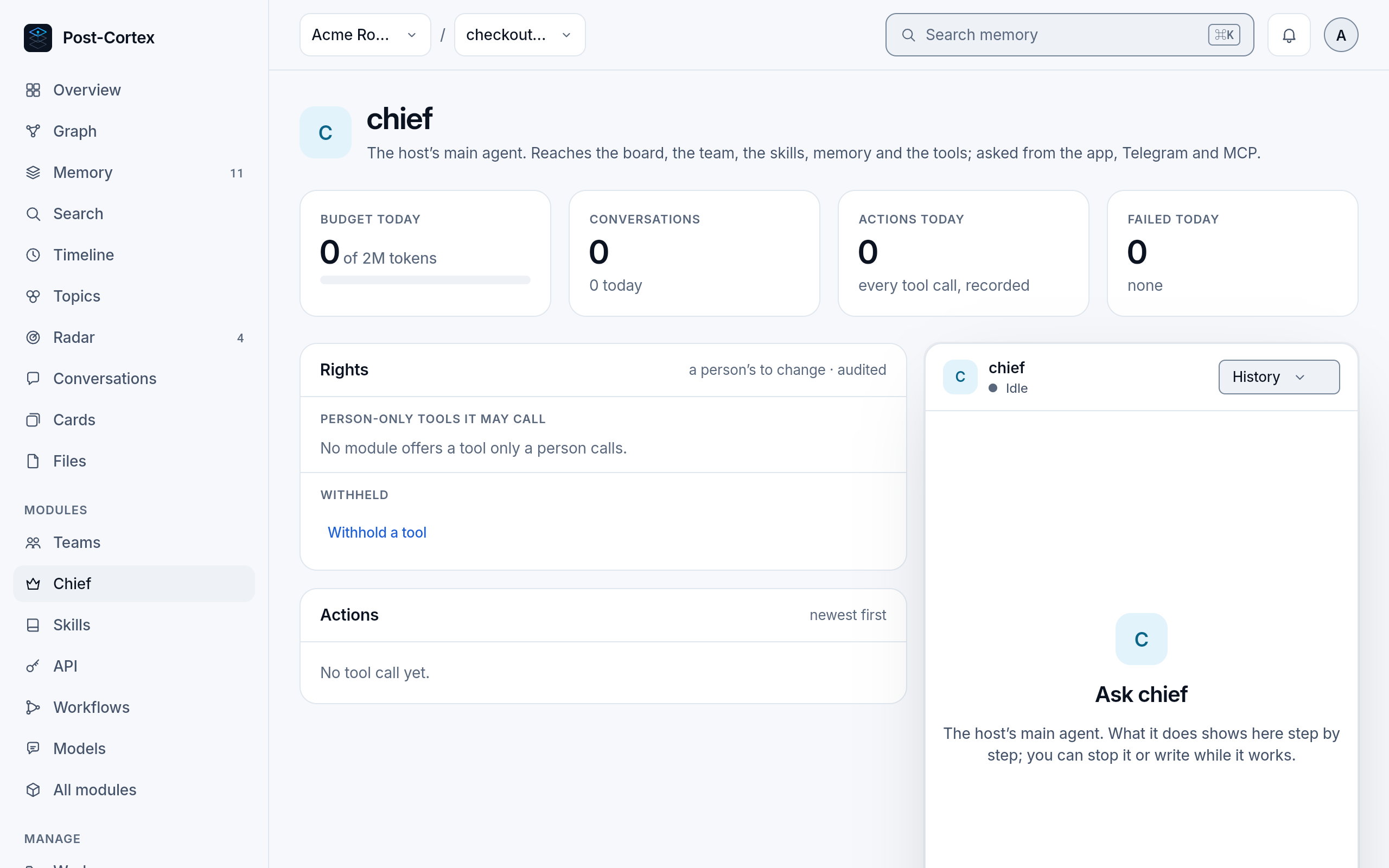
- Budget: a number of model tokens a day, 2,000,000 by default.
- Rights: the tools only a person may call are withheld unless you grant them, one by one. Changing them is a person’s decision and it is audited.
- Actions: every tool call the chief made, newest first.
Skills
Section titled “Skills”A library of instructions in Markdown, for a kind of work: a release checklist, an incident review, how to build a workflow. Every skill is also an MCP prompt of its name, so Claude Code, Codex and any MCP client can use the same skills as the agents of the host.
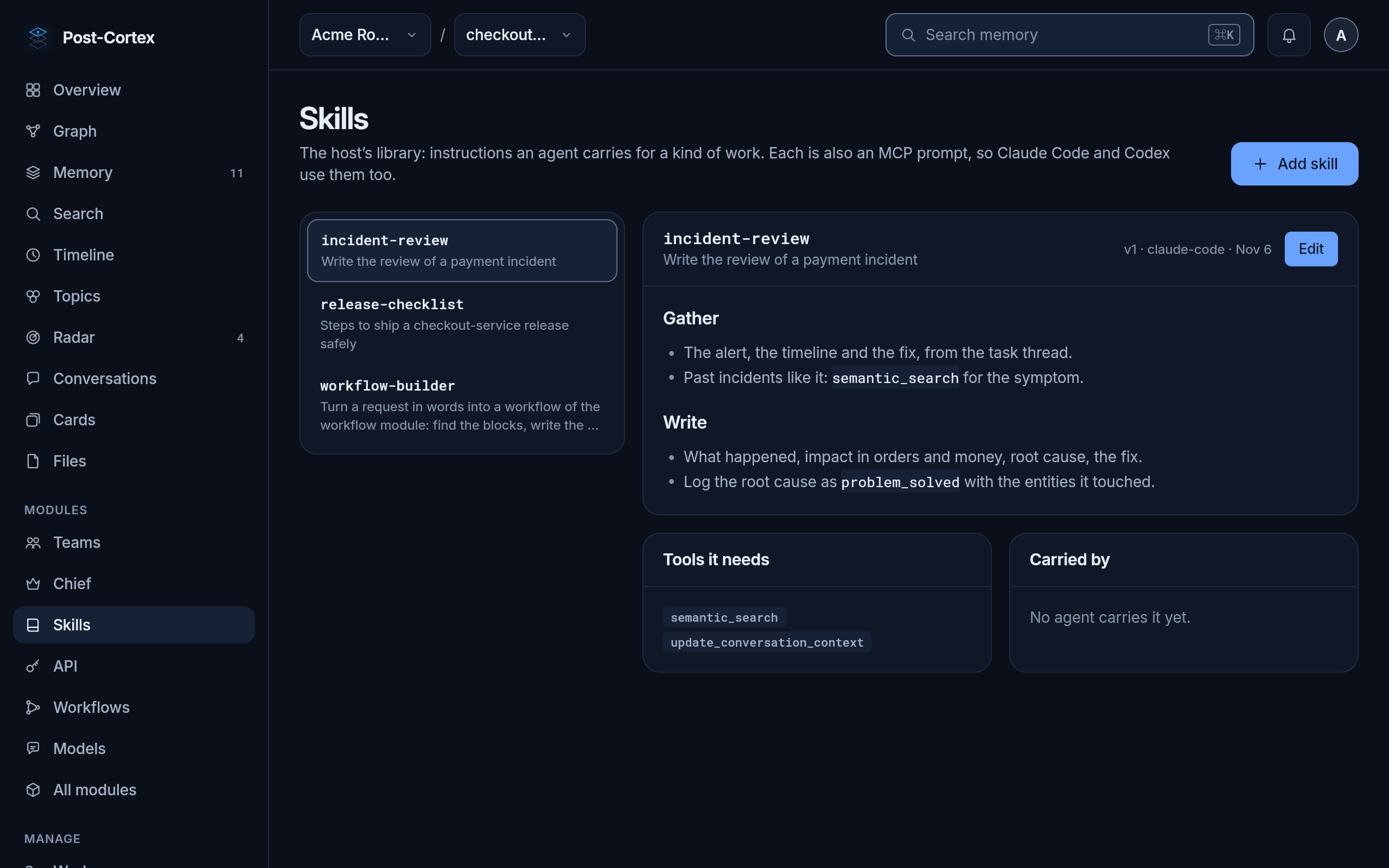
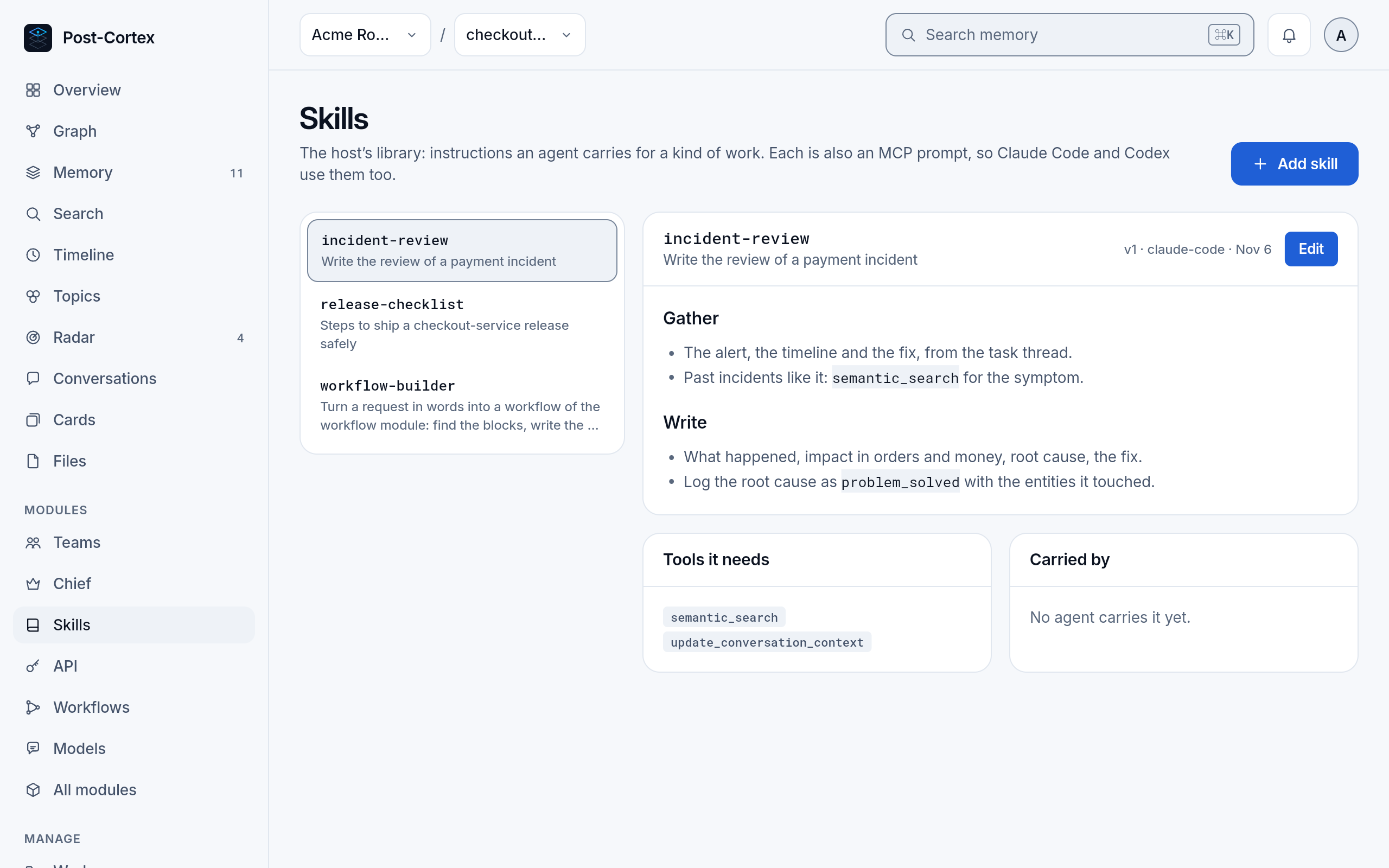
A skill names the tools it needs. A skill runs nothing by itself: a script goes in a code block of its instructions, and the agent runs it with the shell tool (a daemon’s; in an organization in the cloud, its runner’s).