
Profile and usage
Your Profile, in the account menu at the top right, is yours alone: your name, how your records are signed, your user card and how you sign in. Usage and billing, under Manage, is the organization’s: what it used this period.
Profile
Section titled “Profile”- Name and email. A new email is confirmed by a link sent to the new address.
- Author name: records you write are signed with it. Agents sign with their own names, so you always see who wrote what.
- Time zone and theme (light, dark, or the system’s).
- User card: how you work, for every agent and every project. It is yours alone; other people have their own. What it is for: Cards.
- My activity: the records signed with your author name, newest first.
- Personal API keys: the keys you made. Make and revoke them in Connections.
Sign-in and security
Section titled “Sign-in and security”- Two-factor authentication. Turn on shows a QR code: scan it with an authenticator app (1Password, Google Authenticator, Authy) and enter the six digits it shows. Then save your recovery codes: each signs you in once if you lose your phone, and they are shown only then. An organization can require two-factor authentication; with it off, such an organization stops letting you in.
- Signed-in devices, and Sign out everywhere, which signs out every other device.
Deleting your account
Section titled “Deleting your account”Delete account removes your profile, your keys and your sign-ins, after your password or, if you have none, a sign-in of the last 10 minutes; with two-factor authentication on, a code too. An organization where you are the only member is deleted with its memory. An organization you are the last owner of, with other members, has to be handed over or deleted first. It cannot be undone.
Usage and billing
Section titled “Usage and billing”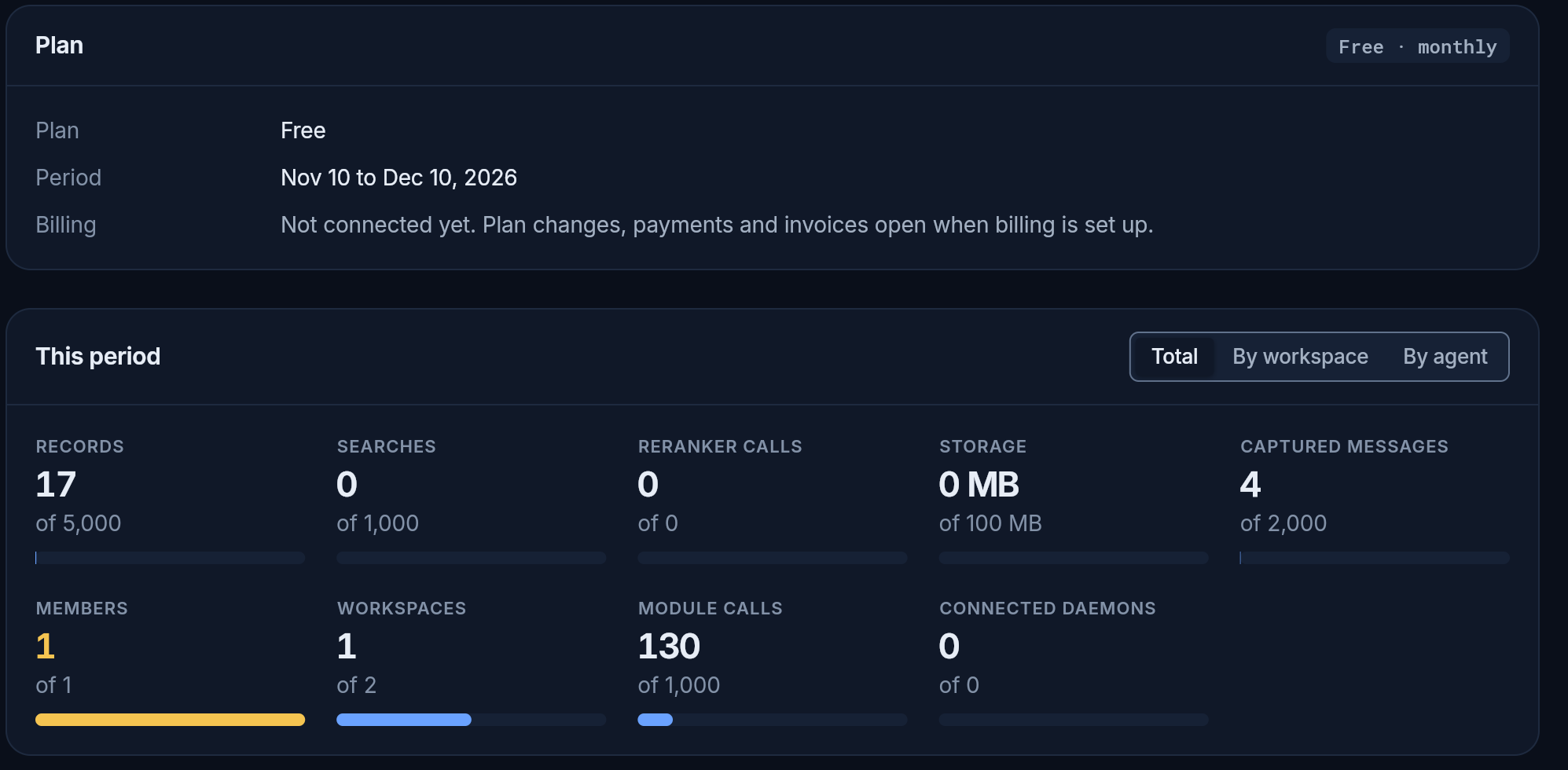
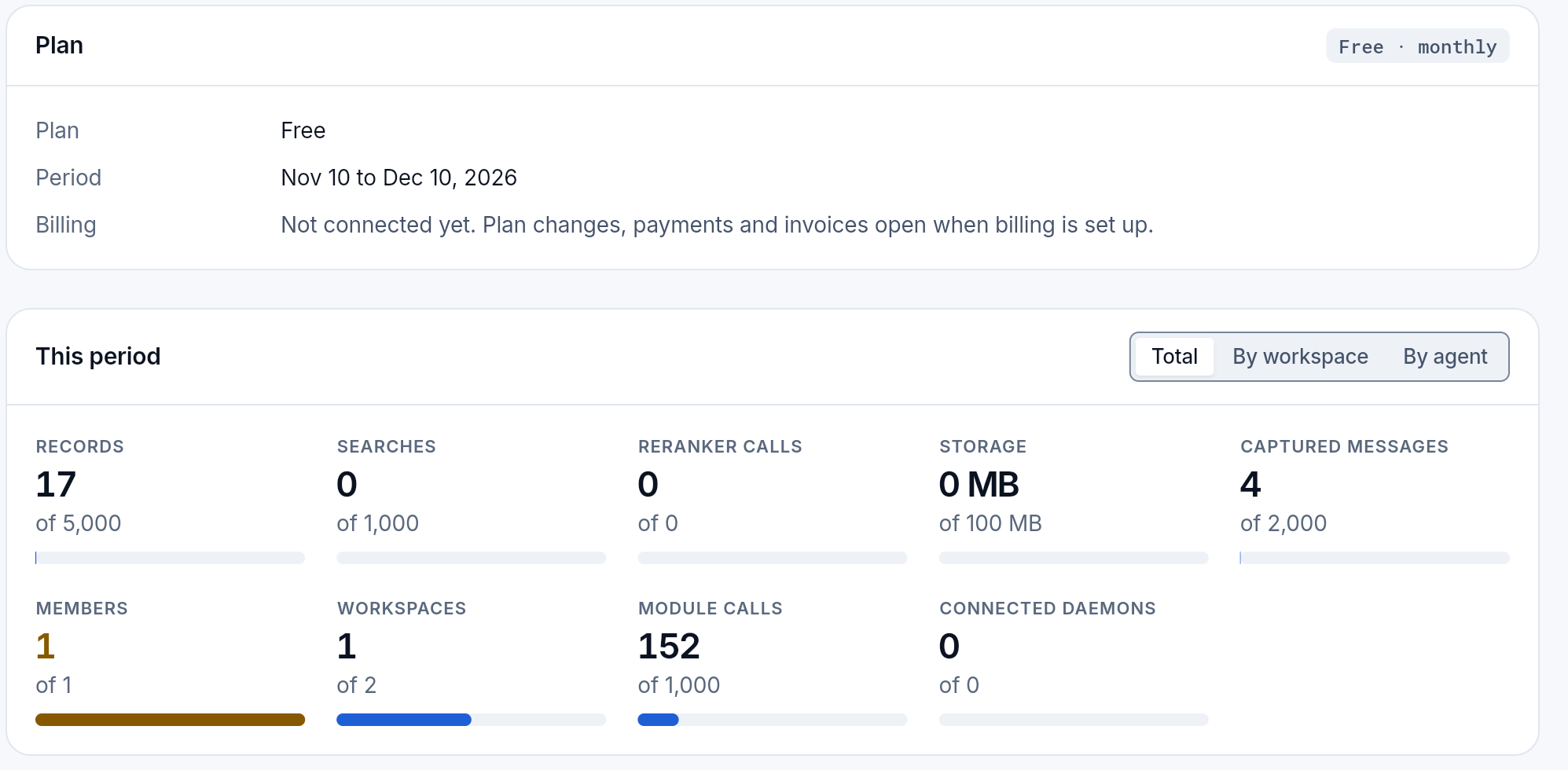
What the organization used this period, against the limits of its plan: records, searches, reranker calls, storage, captured messages, members, workspaces, module calls and connected daemons. By workspace and By agent break the records and reranker calls down, with each one’s share. A limit close to its end is marked, and the page says what happens there.
Only searches a reranker actually ordered count as reranker calls; a search that fell back to the fused ranking does not.